Tactics
Every episode covering Tactics.
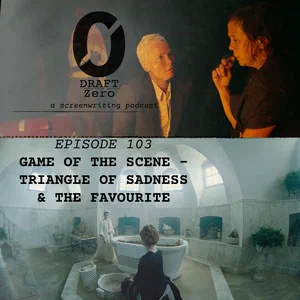
"I think they use different kinds of resources, and that’s what’s interesting, right? So, I kind of think- so, there’s- to bring in a board game concept more than a sports concept, like in board games, you know, you talk about asymmetrical games."
— Stu Willis | DZ-103: Game of the Scene 2 - Triangle of Sadness, The Favourite
Start here
KEY IDEAS
Subtext Emerges From Character Tactics
"I don't think Tony Gilroy sat down and said I'm going to write the best subtext ever. This scene evolves so beautifully from the tactics that the characters are adopting."
— Chas Fisher (00:39:07) · DZ-120: Subtext is Overrated!
Revealing Truth Through Tactical Necessity
"What are you trying to achieve? What is their tactic in revealing the truth of themselves? What is it they want that they've been left with no other recourse other than to reveal the truth of themselves?"
— Chas Fisher (00:07:35) · DZ-120: Subtext is Overrated!
Tactics and Revelation: The Core of Character
"It's just tactics and fear. It is how are you trying to get what you want and what are you willing to reveal to the people in the room."
— Tom Vaughn (00:05:27) · DZ-120: Subtext is Overrated!
Aggressive Waiting
"It's an almost a kind of aggressive waiting, if that makes sense. So whoever has the kind of nerve to live with that tension long enough will be the one who wins. It's a great character beat to have someone who is impatient, foolhardy, furious, angry, slighted, to show them really wanting to act. Just, they have to just do something, but what they actually have to do is wait. And they hate it. And that's a nice little -- yeah. That's a nice way to develop character."
— Damon Young (00:16:28) · DZ-100: Scenes through Swords
Kairos
"There's this notion in Greek culture and philosophy, ancient Greece, that is called kairos, which essentially means the right time. And the right time is different to sort of chronological time, clock time, ticking time. The right time is a kind of felt sense for the right moment. And you can't know ahead of time when that will be. You can't assign a clock time to it. You just have to wait until you know it's right. It's a kind of more organic time."
— Damon Young (00:19:34) · DZ-100: Scenes through Swords
Spent Action
"I'm taking advantage of the moment of that exhaustion when they have the least degrees of freedom. You know, it's going to take them so long to start again. They're already in distance because they've committed to their cut. Everything's going wrong for them. Their sword is as low as it can possibly be. They're going to have to pull it all the way back up and start again."
— Damon Young (00:35:13) · DZ-100: Scenes through Swords
First and Second Intention
"The first intention is not fakery. So if your first intention, for example, is to hit someone with a straight oblique cut to the left side of their head, if they do not parry that or get out of the way, you should 100% cut them on the left side of their head. That is your first intention. If, however, they parry that, then your second intention should be to mouliné around their blade and cut them to the right side of the head. But in both cases, you need to be completely committed. And if you're not completely committed, your first intention's unlikely to work anyway, because they'll know. They'll know that it's a fake."
— Damon Young (00:43:32) · DZ-100: Scenes through Swords