Slug Lines Drive Pacing Through Structure
"the slug lines mimic the editing and how quickly this is all happening. And it really drives the pacing because yeah, it's just action lines so far, but it's not, there's quite a lot of white space on the page because you're going back and forth between what's happening in each location quite quickly."
— Mel Killingsworth
(00:16:59)
· DZ-116: Writing Physical Comedy

How do you make extended technical scenes funny on the page?
AI✦The episode shows how these writers structure extended comedy sequences by setting up geography and running gags first, then interspersing action lines strategically to guide the reader’s eye and timing without over-explaining the visual.✦
Listen to learn how formatting--white space, caps, dashes--becomes your comedy toolkit without a director.
▶
More Info
Mel joins Chas to tackle physical comedy. We limited our homework selection to extended scenes (as opposed to moments and sight gags) in live action projects and – with the help of our Patreons – selected early sequences from BRINGING UP BABY, the pilot for HAPPY ENDINGS and that wonderful food poisoning scene in BRIDESMAIDS…
→
How do you know if you have enough narrative fuel to write a script?
AI✦The hosts discuss using scene questions, beat outlines, and color-coded POV tracking in Arc Studio Pro to determine whether you actually have enough material for a feature-length script.✦
Listen you're not sure whether your idea has enough fuel for 90 pages.
▶
More Info
In this episode, Chas, Stu and Mel attempt to answer a listener question:
“In your own pre-writing process, how do you know you have enough for a feature? And do you have a specific pre-writing method you’re going to?”…
→
What scene-writing tools can be learned from martial arts?
AI✦Stu and Damon frame martial arts distance, timing, and approach as a structural model for how characters move through conflict within a scene.✦
Listen if you want to know why the distance between two characters matters more than what they say.
▶
More Info
In this slightly unusual episode of Draft Zero (but also incredibly on brand), Stu and philosopher-swordsperson Damon Young discuss how the lessons they have learned from martial arts can be applied to scenes. In particular, they discuss how approaching an opponent in a sword fight can be analogous to how characters approach conflict, such as: the distance between the characters, who chooses to engage first, how to feint, how to lure an attack by leaving yourself vulnerable, etc…
→
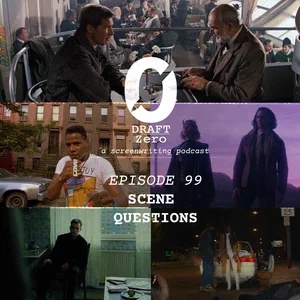
How do audience questions shape scenes?
AI✦By analyzing scenes from LOKI, THE LAST CRUSADE, THE BOURNE SUPREMACY, QUEEN AND SLIM, and DO THE RIGHT THING, Chas and Stu reveal how questions function as the underlying scaffolding of effective scene construction.✦
Listen if learn how to structure individual scenes through the questions you pose to your audience!
▶
More Info
Inspired by our earlier episodes on sequences, Chas and Stu narrow their focus to look at the atomic unit of screen storytelling: the scene. In particular, we breakdown how question and answers prompted in the audience structure individual scenes…
→
How can you create flow and contrast in your dialogue?
AI✦By breaking down key scenes from Fleabag, Juno, and Deadwood, Chas, Stu, and Stephen reveal how dialogue functions as the engine of scene construction and pacing.✦
Listen when you're rewriting dialogue and want to create connection between characters.
▶
More Info
A full three years after the first instalment (and one of our most popular), Stu and Chas have kidnapped Stephen Cleary to once again develop some craft tools around dialogue. It would be fair to say that - in that time - all three have learnt a lot more about dialogue than they knew in 2016. It would be also fair to say that Stephen perhaps learnt a little more through his research into “genderlect”…
→

How can you dramatise your theme on a scene level?
AI✦The episode applies thematic thinking to scene-work, asking whether examining a scene from a thematic perspective impacts the drama, conflict, or stakes within that scene.✦
Listen to discover how a character's worldview becomes the engine of conflict inside a single scene.
▶
More Info
As part of their ongoing exploration of scene-work, Stu and Chas apply their earlier thinking on theme and character worldview to individual scenes. Can examining a scene from a thematic perspective impact the drama, conflict or stakes of the scene? How does your character’s conscious and subconscious world views dramatise the overall theme of the work? How can an individual scene reflect the larger themes of the overall story? Do any of these questions or approaches lead to writing better scenes…
→
How can you successfully integrate exposition into your story?
AI✦By deconstructing scenes from PIRATES OF THE CARIBBEAN, SHORT TERM 12, INSIDE OUT, and others, the episode reveals how successful exposition is embedded within functional scene construction.✦
Listen if your exposition scenes feel like information dumps disguised as dialogue.
▶
More Info
In Draft Zero’s first two part episode, Stu & Chas take an in-depth look at one of screenwriting’s most common challenges: EXPOSITION. For many stories there are pre-existing facts that need to be communicated to the audience — whether those facts be about the rules of the world, the nature of a location, character motivations, character backstories or just character names. So how have great writers made exposition move the story forward, rather than stopping it to tell the audience stuff they need to know…
→
How can films maintain audience interest without stakes or plot questions?
AI✦The episode digs into scene work as the primary technique these filmmakers use to maintain interest when plot takes a backseat, suggesting structure operates at the granular level.✦
Listen if you're writing a character study and unsure how to build momentum without external conflict.
▶
More Info
Continuing their focus on “character”, Stuart and Chas take a close look at films that may be considered character-driven... or rather character studies... or just plot-lite films? Whatever you call them, these films — CHEF, HAPPY-GO-LUCKY, and AMOUR — let their plots take a back seat to a closer examination of their characters. Stuart and Chas dive in to investigate how, without plot driving the story forward, do these films maintain our interest? We talk Mike Leigh’s idea of the ‘Running Condition’, Character Choice, SceneWork and the myriad other techniques the filmmakers use to keep us interested…
→
What can fight scenes - whether physical or verbal - teach us about structuring any scene?
AI✦Stu and Chas use fight scenes as a laboratory for understanding how mid-points, reversals, and escalation function within the architecture of a single scene.✦
Listen to discover how fight scenes can be great inspiration for writing any kind of showdown (verbal or otherwise)
▶
More Info
In exploring how to write good fight scenes, Stu and Chas compare how writers structure memorable showdowns - both verbal and physical. Fights vs arguments. Swords vs insults. Lightsabres vs passive aggressive subtext. To do this, they analyse the showdowns in EASTERN PROMISES, ROB ROY, THE FORCE AWAKENS (yes, yes, we finally let Stu
officially discuss Star Wars), A FEW GOOD MEN, BREAKING BAD and BEFORE SUNSET…
→
How do you keep contained movies engaging?
AI✦Because contained stories eliminate the possibility of scene transitions between locations, the internal architecture of each scene becomes the primary tool for maintaining engagement.✦
Listen if you're writing a contained thriller, drama, or any story limited to a single location
▶
More Info
Contained Thrillers* *seem to be a genre that never goes out of fashion. But being contained is not just limited to thrillers. It’s a way of telling stories on a lower budget, regardless of genre. So - while allegedly easier to make / get made - limiting a story to a single location also limits the tools that maintain an audience’s interest. Changing audience or character point of view, intercutting between locations or characters are all much harder (if not impossible) in contained films. So how do good contained films hook their audience and keep them…
→
What is it about Tarantino's *writing* that elevates his work?
AI✦The episode looks under the hood at how Tarantino builds individual scenes to maximize tension and information, treating scene construction as foundational to his mastery.✦
Listen to steal Tarantino's technique for planting details that detonate as payoffs three scenes later.
▶
More Info
Chapter 1: Of Milk and Men…
→
How does a shift in status or power reveal character?
AI✦Examining status changes as a scene-level phenomenon without relying on plot reveals their understanding of how internal scene mechanics can generate drama on their own.✦
Listen to make your character relatinships more dynamic.
▶
More Info
Stu and Chas explore an idea they both came across studying theatre: status and by extension (or juxtaposition) power. Is a story where a character changes status or experiences loss (or gains) in power more compelling…
→
How do character goals, tactics, and fears create subtext automatically?
AI✦Tom identifies how Tony Gilroy constructs the Michael Clayton scene with three clear emotional movements and beats that create subtext through structure rather than exposition, each beat caused by what came before.✦
Listen if you're struggling to write subtext without it feeling forced!
▶
More Info
Or, how focusing on good drama will result in good subtext. We often hear how subtext is important for good screenwriting. We’re here to tell you it isn’t. Good subtext is a result of good drama, and your focus should be on creating that good drama. But how…
→
How and why should every scene have an emotional event?
AI✦By breaking down beats and the moment-to-moment texture of three specific scenes, Judith and the hosts model how emotional events function as the fundamental building block of scene construction.✦
Listen to understand why a scene's power lives in what shifts between characters, not what happens to them.
▶
More Info
How and why should every scene have an emotional event?…
→
How can scenes where characters are alone increase our connection with them?
AI✦The hosts break down specific scenes to show how solitude sequences are structured differently than scenes with antagonism or dialogue-driven conflict.✦
Listen to understand how solitude reveals character interiority and deepens audience connection
▶
More Info
In this episode, we explore the audience’s connection with characters through the lens of characters being alone…
→
How can games elevate dramatic scenes?
AI✦Games provide a structural framework that organizes how characters interact within a scene, replacing generic dialogue with rule-based competition that generates both conflict and character revelation.✦
Listen to understand how games force characters to interact and reveal themselves (through competency, decisions, and rule-breaking)
▶
More Info
In part two of this two parter, Stu and Chas go further into the game (of the scene) and look at how games force characters
other than the protagonist to interact. We deep dive into the wonderful social satires of TRIANGLE OF SADNESS and THE FAVOURITE…
→
How can 'games' help us write better scenes?
AI✦By mapping a scene’s game--its players, stakes, and win conditions--Stu and Chas show how to build scenes with clearer internal logic and momentum.✦
Listen to make your scene writing more dynamic (by looking at the underlying game)
▶
More Info
Stu and Chas turn their attention to a topic that has long eluded them: the game of the scene. We look at how considering the game that characters are playing — its rules, arenas, players, referees, and win conditions — can help you write more dynamic scenes…
→
What can we learn by analysing how 'oners' are written on the page?
AI✦By closely reading the actual words on the page, the hosts show how oners are structured through anchoring action and camera positions that create coherent, flowing sequences.✦
Listen to understand how screenwriters direct the camera without calling shots.
▶
More Info
Chas, Stu and Mel reunite to talk about writing the
feel of camerawork in screenplays. We use “oners” — a long-playing continuous take — as a lens to talk about how some writers have “directed” from the page. We talk immediacy, camera positions, handovers, and anchoring action and more…
→
What gives your sequences their intensity?
AI✦By examining sequences through BOURNE IDENTITY, FARGO, and CHILDREN OF MEN, Stephen reveals how the internal structure of scenes compounds to create different intensities based on question type.✦
Listen to understand how dramatic questions shape audience engagement and pacing through sequences.
▶
More Info
Chas and Stu are joined for the fourth time by the inestimable Stephen Cleary - this time to take a deep dive into sequences. A real deep dive. A 3+ hour deep dive…
→
How do tactics make your characters and scenes more dynamic?
AI✦The episode uses close analysis of individual scenes from ZODIAC and TRAINING DAY to show how shifting tactics between characters creates dynamic scene work.✦
Listen to learn how a character's tactics reveal who they are under pressure--and how their changing tactics reveals their growth.
▶
More Info
In this episode, Stu and Chas turn their gaze to the “tactics” that characters use in scenes to get what they want. Tactics are
how the characters try to achieve their goals and (we reckon) can be revealing of the essence of their character. The shifting and thwarting of tactics can make scenes more dynamic; while over the course of a story, the changing of tactics can reflect the growth of characters... even if their goal stays the same…
→
How can you recreate the feeling of cinematic high-tension on the page?
AI✦These high-tension sequences are examined as structured units, revealing how screenwriters architect fear through the internal mechanics of individual scenes.✦
Listen if you want to evoke fear and tension using only the written word (without relying on camera, lighting, music, or sound).
▶
More Info
Chas & Stu take a close look at sequences of high-tension - the ones that make you lean forward in fear, or jump backwards in terror. Without camera angles, lighting, music or sound, how can screenwriters can evoke those emotions in readers using only the page? These sequences can be found in any genre of film, not just thriller or horror. To that end, Stu and Chas dive into high tension scenes from NO COUNTRY FOR OLD MEN, ZODIAC, ROOM, and THE BABADOOK. We cover their use of shifting POV, Dramatic Irony, Status Transactions, White Space, Sound FX, and many more…
→
Does manipulating time on the page make your script feel more cinematic?
AI✦Khrob and the hosts discuss how decompression and compression work within individual scenes to manipulate reader perception of time passing, connecting grammar choices to scene-level filmmaking decisions.✦
Listen if you want your screenplay to feel cinematic before a director ever reads it.
▶
More Info
Chas and Stu are joined by Khrob Edmonds - an award-winning filmmaker - to discuss manipulation of time…
→
How can we make our screenwriting more appealing to Actors?
AI✦By examining specific scenes from the play-to-screen adaptation, the conversation shows how scene construction either enables or constrains an actor’s ability to find and execute character objectives.✦
Listen to understand how writers can craft more compelling material for actors (and how they approach scripts)
▶
More Info
In this episode, Chas and Stu are joined by a very special guest, SARAH SNOOK - star of Succession, Predestination, Jessabelle, and Oddball, amongst many others - to discuss ACTING and it’s relationship with WRITING…
→
Can one scene be the key to unlocking the whole story?
AI✦Stu and Chas examine how scenes from THE GODFATHER, THE DARK KNIGHT, and THE RAID 2 function as structural keystones that mirror the larger narrative.✦
Listen if you want to understand how a single key scene between protagonist and antagonist can unlock the entire structure of your story!
▶
More Info
Can one scene be the key to unlocking the whole story…
→
Can forcing your audience to ask questions - and then answering them - trigger an emotional response?
AI✦Stu and Chas analyze how individual scenes and sequences use shifts in audience point of view to heighten the desired emotional response within discrete dramatic units.✦
Listen to learn about the most powerful tool in screenwriting: narrative POV.
▶
More Info
Stu and Chas delve into audience point of view - not character point of view! Does your audience know more, less or the same as your characters? And does changing this within a scene trigger or heighten the desired emotional response…
→

How can interweaving two timelines change how we feel about a character?
AI✦The episode tracks how Sorkin structures individual scenes across multiple timelines, managing the rhythm of intercutting and the pacing of information reveals within the TOMBS cycle.✦
Listen to understand how manage stakes when you're using flashforwards.
▶
More Info
In this Part 2 of Interweaving Timelines (aka The Stu Monologue Episode), Mel, Chas and Stu tackle Sorkin/Fincher’s The Social Network. As you’ll hear, it is clearly Stu’s favourite of the examples we cover and, ah,
not Mel’s favourite. While all three bring their own biases and opinions on the reality of Facebook as it has become, we do manage to put the destruction of democracy to one side to actually analyse the meticulous craft that this film displays…
→

Workshopping ways to fix character motivations.
AI✦By examining specific scenes where motivation fails, Chas and Stu show how the architecture of a scene either creates the conditions for belief or leaves character decisions hanging.✦
Listen if you want to understand how character decisions can break a screenplay and how to fix them
▶
More Info
In this second part of their exploration of character motivations, Chas and Stu dive into what makes “BAD” screenplays NOT work. They examine at moments where they (and maybe you, dear listeners) did not believe a key decision being made by a character and so were taken out of the movie. In a departure from the Draft Zero format, they apply the tools they developed in Part 1 to workshop potential fixes to these beats…
→