"I do think in comedy, it’s especially challenging to get readers to read the big print. You know, so much of the humour comes from the dialogue, and comedy is such a dialogue. Often, certainly contemporary comedy is so dialogue-driven."
— Chas Fisher | DZ-116: Writing Physical Comedy
Trusting the Audience
"The trend the last decade or so is not to trust the audience and you can't have these references, they're not going to get it. It doesn't care whether you get it or not. It just cares, is this interesting? And the combination of those two things, the structure and the content, is how the pacing plays out."
— Mel Killingsworth
(00:10:04)
· DZ-125: Oscars One-shot - BLUE MOON
Dialogue-Driven Comedy and the Big Print Challenge
"I do think in comedy, it's especially challenging to get readers to read the big print. You know, so much of the humour comes from the dialogue, and comedy is such a dialogue. Often, certainly contemporary comedy is so dialogue-driven."
— Chas Fisher
(00:11:43)
· DZ-116: Writing Physical Comedy
Rewriting for Character Consistency
"I think the two main things that I find really need fixing when I hit the end of my first drafts is that I've updated the character sheet, but now I realize the whole first half, everything they're doing makes no sense. The other thing is that if you have an ensemble piece, all of the characters sound quite the same."
— Mel Killingsworth
(00:27:25)
· DZ-106: How do you know if you have enough story?
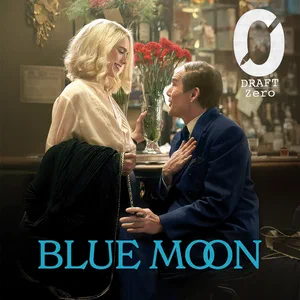
What craft tools make a low-budget, contained, period drama riveting?
AI✦Chas and Mel dissect how nearly every line of dialogue functions as a hook, a play on words, or a callback, with pop culture references woven through 1940s context in ways that don’t require prior knowledge to land, and how this demands performers who can keep up with the repartee.✦
Listen if you want to understand how narrative POV, screenplay format, and dialogue craft can elevate a contained biopic into an Oscar-nominated film
▶
More Info
BLUE MOON is a talky, period-drama that film about an obscure songer-writer in the 1940s. Yet, it attracted world-class talent AND Academy Award nominations, including for it’s script. Join Chas & Mel as they explore how narrative POV, interweaving relationships, hooky dialogue, and even the screenplay format itself make the script for BLUE MOON so great…
→
How can you do powerful storytelling... without dialogue?
AI✦The hosts examine what happens when you strip dialogue down to grunts and a single memorable line, forcing every other storytelling tool to carry the weight of character and plot.✦
Listen to hear how visual storytelling can carry an entire narrative with minimal dialogue.
▶
More Info
Stu and Chas are joined by filmmaker, podcaster and writer Lia Matthew Brownn to deep dive into FURY ROAD and its astounding
visual storytelling, both on the page and on screen. We talk about setups and payoffs, given circumstances, image systems, environmental storytelling, and how the relationship between Furiosa and Max is built over the course of the story with very little dialogue (besides Tom Hardy’s grunts and the odd bellow of “MEDIOCRE!”).
You can also watch the complete live stream on YouTube or just the breakdown of the Furiosa/Max fight (which isn’t in the podcast) here:
https://www.youtube.com/watch?v=f8uYAbEcQeQ&feature=youtu.be…
→
How can the Trinity Syndrome help you write better secondary characters?
AI✦The Bechdel Test anchors the conversation around whether female characters speak to each other about something other than men, making dialogue a diagnostic tool for catching the Trinity Syndrome in your own work.✦
Listen when you're writing secondary female characters and need them to have more depth.
▶
More Info
Chas & Stu are joined by Bamboo Killer (aka Emily Blake) - one of the co-hosts of the
Chicks Who Script podcast. They take a critical look at secondary female characters in mainstream movies through the lens of the oft-cited Bechdel test and the new, less-cited, Trinity Syndrome. The Trinity Syndrome berates movies for creating a
“Strong Female Character With Nothing To Do” (like Trinity in the Matrix sequels) and raises a list of questions for filmmakers to ask themselves about their (female) characters…
→
How do you make extended technical scenes funny on the page?
AI✦Chas observes that in Happy Endings, the dialogue serves a structural function--riffing lines keep David talking as he moves through space to set up the next gag, rather than cutting between short scenes that would lose the physical humor.✦
Listen to learn how formatting--white space, caps, dashes--becomes your comedy toolkit without a director.
▶
More Info
Mel joins Chas to tackle physical comedy. We limited our homework selection to extended scenes (as opposed to moments and sight gags) in live action projects and – with the help of our Patreons – selected early sequences from BRINGING UP BABY, the pilot for HAPPY ENDINGS and that wonderful food poisoning scene in BRIDESMAIDS…
→

What magic do Christmas movies use to make them so rewatchable?
AI✦Snappy dialogue emerges as one of the key elements Mel and the cohosts credit for making these films durable enough to survive seasonal rewatch cycles.✦
Listen if you want to understand what makes holiday films enduring parts of our seasonal rituals!
▶
More Info
In this “backmatter” episode of Draft Zero, Stu, Chas, and Mel Killingsworth embark on a festive exploration of what makes holiday films so engaging and so re-watchable that they can become part of our rituals. To that end, we breakdown the charm of of Christmas films like KISS KISS BANG BANG, RIDERS OF JUSTICE, and IT’S A WONDERFUL LIFE…
→
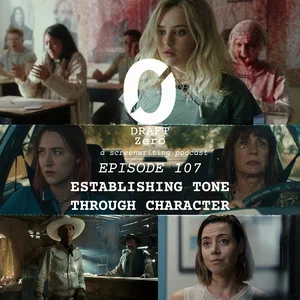
How can we use dramatisation to create tone?
AI✦Chas and Stu discuss minimalism versus maximalism in dialogue as a specific tonal lever, showing how the amount and style of character speech shapes whether a film feels restrained or expansive in its emotional register.✦
Listen if you want to understand how character actions and reactions shape a film's tone
▶
More Info
In this episode, Chas and Stu continue their deep dive into how to write tone by examining films with “light” (we use the phrase loosely) tones: LADY BIRD, EMILY THE CRIMINAL, THE BALLAD OF BUSTER SCRUGGS, and SPONTANEOUS. We also talk a surprising amount about DUNE and CRAZY STUPID LOVE…
→
What can we learn from Sofia Coppola's on-the-page skills over her career?
AI✦Coppola’s dialogue choices--what characters say and don’t say--function as a primary tool for revealing character performance on the page across LOST IN TRANSLATION, THE BLING RING, and THE BEGUILED.✦
Listen to discover how Sofia Coppola crafts character performance on the page and uses whitespace to create her distinctive cinematic voice
▶
More Info
Following the success of the Tips from Tarantino episode, we have again decided to look at three different scripts from over the course of a long screenwriting career from a single writer to see what we can learn. Our beloved patreons not only selected Sofia Coppola as said writer, but also selected the scripts to analyse: LOST IN TRANSLATION, THE BLING RING and THE BEGUILED…
→
How can you let your characters tell us how they feel?
AI✦This episode directly addresses how to use dialogue in reunion and first-meeting scenes to let characters tell us who they are rather than what happened.✦
Listen to understand why what a character *doesn't* say reveals more than exposition ever could.
▶
More Info
In watching Season 7 (and the first three episodes of Season 8) of Game of Thrones, Stu noticed that there were lots of scenes where characters either met for the first time or were reunited after a long time apart. In these scenes, the audience knows (or thinks they know) more than either character. And so the fascination, power and subversion comes from what the characters choose to reveal... or not…
→
How can exposition twist your story in new directions?
AI✦The hosts examine how dialogue is often the vehicle for exposition and explore when that choice works versus when it signals a writer going wrong.✦
Listen to learn how to use exposition as dramatic revelation rather than mere information delivery.
▶
More Info
In the second part of Draft Zero’s two-part episode on “Exposition”, Stu & Chas take an even deeper look at this notoriously challenging part of screenwriting. For many stories there are pre-existing facts (or given circumstances) that need to be communicated to an audience, and often we rely on dialogue to do it. But exposition can do more than just communicate, it can serve as dramatic revelation that twists a story into a new direction or provides an emotional payoff - or both!. So how do great writers make exposition work for the story, rather than just tell audience stuff they need to know? And how can writers go wrong…
→
How can you successfully integrate exposition into your story?
AI✦Much of the episode’s examination hinges on how exposition lives in what characters say and how that dialogue can serve multiple functions simultaneously--advancing plot, revealing character, and communicating necessary facts.✦
Listen if your exposition scenes feel like information dumps disguised as dialogue.
▶
More Info
In Draft Zero’s first two part episode, Stu & Chas take an in-depth look at one of screenwriting’s most common challenges: EXPOSITION. For many stories there are pre-existing facts that need to be communicated to the audience — whether those facts be about the rules of the world, the nature of a location, character motivations, character backstories or just character names. So how have great writers made exposition move the story forward, rather than stopping it to tell the audience stuff they need to know…
→
How can we make our screenwriting more appealing to Actors?
AI✦Tracy Letts’s dialogue--drawn from his background as both playwright and actor--demonstrates how writers can craft lines that feel natural while giving actors rich material to perform.✦
Listen to understand how writers can craft more compelling material for actors (and how they approach scripts)
▶
More Info
In this episode, Chas and Stu are joined by a very special guest, SARAH SNOOK - star of Succession, Predestination, Jessabelle, and Oddball, amongst many others - to discuss ACTING and it’s relationship with WRITING…
→