"She is way more vulnerable with us as the audience than she presents to other people. Right. She does not share what’s happened to her mom, to any other character."
— Chas Fisher | DZ-110: Voiceover
Assholes Who Are Completely Relatable
"I really enjoyed tying the, like, just the fact that you're able to draw these sorts of connections between, you know, like an insurance salesman and a post-war, you know, a GI, like all of those sorts of things are really fascinating. And I think writing characters that are assholes, but are completely relatable"
— Mel Killingsworth
(01:04:35)
· DZ-124: Making the Despicable Compelling
The Yin-Yang: Peaks And Troughs Of Sympathy
"What's really interesting about Hot Fuzz is in the first couple of pages, they could be setting up a James Bond character. Effectively, that kind of almost bulletproof action hero, right? And then, after they've done that kind of, like, escalation, then they start deconstructing it. And this is a pattern that As Good as It Gets also does very well. There's this kind of yin-yang or this peak and trough with our perceptions of the character that they play with to make it, in my mind, make the character both unlikable yet compelling."
— Stu Willis
(00:13:35)
· DZ-3: Making Unlikeable Protagonists Compelling
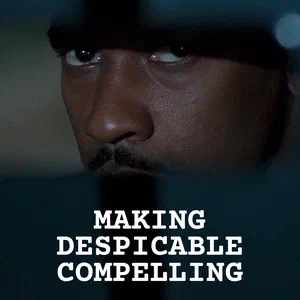
How does Film Noir show us terrible people doing terrible things without endorsing it?
AI✦The episode shows how voiceover and character motivation--giving audiences access to why a character makes an incredibly stupid but understandable choice--lets you jump over narrative hurdles that might otherwise lose the audience.✦
Listen if you need audiences to root for characters who do terrible things
▶
More Info
Mel and Chas continue to explore what Noir (the genre) can teach writers of all other genres. In particular:…
→
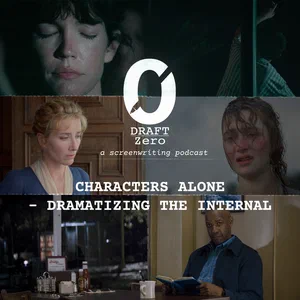
How can scenes where characters are alone increase our connection with them?
AI✦By examining how solitude creates intimacy between character and audience, Chas and Stu show that witnessing vulnerability when no one else is watching builds connection.✦
Listen to understand how solitude reveals character interiority and deepens audience connection
▶
More Info
In this episode, we explore the audience’s connection with characters through the lens of characters being alone…
→

What can screenwriters learn from the storytelling techniques used by stand-up comedians?
AI✦The rhetorical concept of pathos--how the audience emotionally engages--becomes the key tool for understanding why stand-ups can move viewers to both laughter and catharsis.✦
Listen if you want to understand how stand-up comedians grip audiences and build emotional arcs (and what narrative tools screenwriters can borrow from comedy)!
▶
More Info
Standup comedians can keep audiences gripped to their every word for over an hour, and often bring them to emotional climaxes by the end. So how do they do it and what tools can apply to scripted narratives…
→
How can interweaving two timelines change how we feel about a character?
AI✦The episode’s core work is examining how the interweaving timelines change how the audience feel about Mark Zuckerberg, and whether Sorkin’s structure creates sympathy or something more complex.✦
Listen to understand how manage stakes when you're using flashforwards.
▶
More Info
In this Part 2 of Interweaving Timelines (aka The Stu Monologue Episode), Mel, Chas and Stu tackle Sorkin/Fincher’s The Social Network. As you’ll hear, it is clearly Stu’s favourite of the examples we cover and, ah,
not Mel’s favourite. While all three bring their own biases and opinions on the reality of Facebook as it has become, we do manage to put the destruction of democracy to one side to actually analyse the meticulous craft that this film displays…
→
Do you want your audience feeling with or for your characters?
AI✦The episode distinguishes between positioning your audience to sympathise with characters--being rocked by surprise after the fact--versus other modes of connection.✦
Listen if you're interested in how to dramatise character change, position your audience in relation to characters, and explore the difference between empathy and sympathy in screenwriting
▶
More Info
One day, Chas saw
Avengers: Endgame for the second time and wrote a review on Letterboxd. In particular, he had issues with how little he perceived the characters of Cap and Tony changed within the film, their big finale (spoiler). Then friend and patron of the podcast Julio Olivera vehemently disagreed in the comments. He was egged on by Stu. And there in the comments began a debate that looked a lot like an episode of Draft Zero. So we decided to make it one…
→
Will Director Stu allow Writer Chas on his set?
AI✦The hosts investigate how consequences of character actions do heavy lifting in determining whether audiences will sympathize with or reject a character.✦
Listen to understand how consequences (not intentions) impact whether an audience roots for or against your protagonist.
▶
More Info
Following our annual wrap up in 2017, we’ve decided to once again explore what craft issues/lessons we can garner from the latest Stars, namely Episode VIII: The Last Jedi, focusing on how consequences of character actions can do a lot of heavy lifting as to how the audience perceives that character (as well as looking at worldview and overall story structure)…
→
How do you make unlikeable characters compelling to watch... in drama?
AI✦The central question asks how screenwriters generate audience buy-in for unlikeable characters, which means finding ways to make viewers care about people they’d otherwise despise.✦
Listen when you're writing a protagonist who does terrible things but you need the audience to keep watching.
▶
More Info
Stu and Chas revisit a topic from a year ago: how do screenwriters make unlikeable characters compelling? This time, we turn our focus to dramas and analyse how AMERICAN HISTORY X, YOUNG ADULT, NIGHTCRAWLER all make their asshole protagonists compelling to watch. We expand our original list of five writer’s tools to include a few more for your tool belt…
→
How do you keep an audience watching a character everyone in the film hates?
AI✦Chas and Stu identify specific techniques )the yin-yang oscillation of cruelty followed by complicating beats, extreme behavior that provokes laughter rather than recoil) that allow audiences to care about deeply flawed protagonists despite their unlikability.✦
Listen if you want to make audiences care about deeply flawed protagonists!
▶
More Info
Stu and Chas tackle the first 20 pages of HOT FUZZ, AS GOOD AS IT GETS and GROUNDHOG DAY and try to work out what stops these a-holes protoganist from pushing the audience out of the movie…
→
How can you use voiceover without it feeling like a cheat?
AI✦Stu shows how voiceover, when timed from the right moment in the character’s timeline, becomes a direct pipeline to viewer empathy and investment.✦
Listen to explore how voiceover can set tone, reveal character, enhance empathy, and create tension.
▶
More Info
How can you use Voiceover without it feeling like a cheat?…
→
How can you create flow and contrast in your dialogue?
AI✦The hosts use dialogue analysis to show how empathy is built between character and audience, identifying which scenes generate connection through how characters speak.✦
Listen when you're rewriting dialogue and want to create connection between characters.
▶
More Info
A full three years after the first instalment (and one of our most popular), Stu and Chas have kidnapped Stephen Cleary to once again develop some craft tools around dialogue. It would be fair to say that - in that time - all three have learnt a lot more about dialogue than they knew in 2016. It would be also fair to say that Stephen perhaps learnt a little more through his research into “genderlect”…
→
Workshopping ways to fix character motivations.
AI✦When characters make decisions the audience doesn’t believe, sympathy fractures; Chas and Stu trace how failures of motivation directly undermine the emotional contract with viewers.✦
Listen if you want to understand how character decisions can break a screenplay and how to fix them
▶
More Info
In this second part of their exploration of character motivations, Chas and Stu dive into what makes “BAD” screenplays NOT work. They examine at moments where they (and maybe you, dear listeners) did not believe a key decision being made by a character and so were taken out of the movie. In a departure from the Draft Zero format, they apply the tools they developed in Part 1 to workshop potential fixes to these beats…
→
What questions do you want your audience asking at any given time?
AI✦The episode examines how deciding what the audience knows and when can organise your story around the audience following a character, feeling concerned about them, or empathising with them through deliberate POV control.✦
Listen if you want to understand how narrative point of view can organise your entire story structure
▶
More Info
Waaaaaaaaaay back in DZ-5, Stu and Chas examined how shifting narrative point of view (i.e. what the audience knows in relation to the characters on screen) heightens emotions in any given scene. We’ve now taken that micro idea and applied it to the macro: how can deciding what the audience knows and when in relation to the characters organise your story? Are whole sequences or even acts driven by the audience following a character, feeling concerned about a character, empathising with a character or being absorbed in the irony of knowing more than all the characters interacting on screen…
→
How does the experience of a character's decision impact our feelings towards that character?
AI✦By comparing Sansa’s absent POV in one episode to Cersei’s present POV in another, Chas and Stu show how a writer’s choice to show or hide a character’s decision-making directly shapes whether an audience feels aligned with or alienated from that character.✦
▶
More Info
After a spectacular end to Season 6 of GAME OF THRONES, Chas and Stu were struck by the very different portrayals of Sansa in
Episode 9 - Battle of the Bastards and Cersei in
Episode 10 - The Winds of Winter. Despite both characters having an enormous impact on the narrative, the audience’s experience of those characters is very different -- largely because Sansa is absent from 98% of Battle of the Bastards…
→
How does splitting 'character functions' enhance theme?
AI✦The episode challenges the assumption that your primary character needs to be likeable, showing that you can distribute sympathy across your ensemble by giving different characters different functions to fulfill.✦
Listen to see how splitting character functions across your cast sharpens what your story actually means.
▶
More Info
We are often told that our ‘protagonist’ needs to be a active. That they need to be compelling. That they need to change. And - old faithful - that they need to be likeable. But after looking at MAD MAX: FURY ROAD, STAR TREK (2009), THE FIGHTER, and SICARIO, Chas and Stu learn that your primary character does not need to do
all these things. In fact, they learn that splitting these functions between your primary characters can reinforce theme and create potential for different types of narratives…
→