
§ RESOURCES / TOPICS / Unreliable Narrator
Unreliable Narrator
Every episode covering Unreliable Narrator.
"Sometimes there’s such a huge emotional impact that you might overstate how big the tonal shift is in memory."
— Mel Killingsworth | DZ-117: Pulling Off Tonal Shifts
Start here
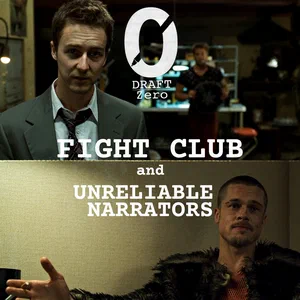
DZ-111: Unreliable Narrators and FIGHT CLUB
How does the unreliability of a narrator impact the way a story is told?
AI✦Stu and Mel dissect what makes Jack an unreliable narrator and how his control over the storytelling fundamentally shapes what the audience believes they’re witnessing.✦
Listen to learn how unreliable narrators shape storytelling through voiceover, structure, and control.
▶ More Info
In this episode, Stu and Mel (sans Chas!) take a deep dive into FIGHT CLUB and its use of the unreliable narrator. This is a bridging episode between our previous episode on VOICEOVER and our forthcoming episode on TALKING TO CAMERA as Fight Club does both.… →
Films:
Fight Club (1999)
Even More
DZ-124: Making the Despicable Compelling
How does Film Noir show us terrible people doing terrible things without endorsing it?
AI✦Easy’s voiceover in Devil in a Blue Dress gives you access to his motivations such that you’ll jump over narrative hurdles, but it also conceals his complicity in covering up murders--the narration shapes what you believe about him.✦
Listen if you need audiences to root for characters who do terrible things
▶ More Info
Mel and Chas continue to explore what Noir (the genre) can teach writers of all other genres. In particular:… →
DZ-117: Pulling Off Tonal Shifts
How can we teach our audience new storytelling rules in the middle of our story?
AI✦Swiss Army Man’s tonal shift hinges on introducing Sarah’s POV for the first time, breaking free from Hank’s unreliable fantasy and forcing the audience to reckon with what’s actually true in the world.✦
Listen if you want to write tonal pivots that land on the page without a director's toolkit.
▶ More Info
Following on from our episodes on establishing tone through action lines and through character, this is what we have been building up to: how to pull off a tonal switch… that does NOT throw the audience out of the film. And, in particular, how to pull that off on the page when writers don’t have framing, lighting, music, editing, etc. at our disposal… →
DZ-110: Voiceover
How can you use voiceover without it feeling like a cheat?
AI✦The Backmatter question about a twist relying on the audience believing the narrator is a different character until Act III hinges on how voiceover can deceive through voice recognition and casting choices.✦
Listen to explore how voiceover can set tone, reveal character, enhance empathy, and create tension.
▶ More Info
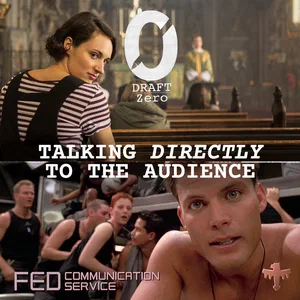
DZ-109: Talking DIRECTLY to your audience
What are the different ways a filmmaker can ask something of the audience?
AI✦The hosts examine reliability as a key question--what does the person talking know?--using The Usual Suspects and Fight Club to show how an unreliable narrator’s limited or false knowledge shapes what the audience believes.✦
Listen if you've wondered what a character actually wants when they're talking directly to the audience!?
▶ More Info
What are the different ways a filmmaker can ask something of the audience… →
Films:
Fight Club (1999)
, Fleabag (2016)
, The Big Short (2015)
, F for Fake (1973)
, Star Wars (1977)
DZ-53: Antagonists! 5 - vs Audience
What if there is no antagonist?
AI✦F for Fake and Sans Soleil use narrative deception as their primary antagonistic force, making the audience question what they’re being told and by whom.✦
Listen to turn narrative uncertainty itself into the engine that keeps viewers compelled.
▶ More Info
It’s time. The Epic Deep Dive(TM) into Antagonists has reached its shuddering conclusion. And for this Part V - by choosing films that have no obvious singular antagonist (and in some cases no obvious narrative either) - Stu and Chas realised there was indeed a final category of antagonists: the films themselves. Where the film (and the filmmaker) are engaging directly with the audience. Where the films are... VERSUS AUDIENCE… →
Films:
Ocean's Eight (2018)
, The Second (2018)
, F for Fake (1973)
, Sans Soleil (1983)
, Forrest Gump (1994)