§ RESOURCES / TOPICS / Fourth Wall
Fourth Wall
Every episode covering Fourth Wall.
"How much control of the narrative are you giving to the character? And it was nice to see how much the differences between Fleabag and High Fidelity are directorial and visual as much as anything else."
— Chas Fisher | DZ-112: Breaking the 4th wall
Start here
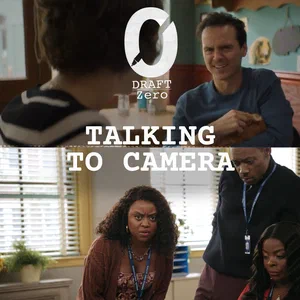
DZ-112: Breaking the 4th wall
How is the effect of breaking the 4th wall different to voiceover?
AI✦Mel, Chas, and Stu examine breaking the fourth wall as the most blatant tool of direct audience communication, analyzing how characters looking directly at the camera create a fundamentally different effect than voiceover.✦
Listen to understand how breaking the 4th wall directly involves the audience in a character's emotional present.
▶ More Info
As part of our series on how filmmakers can directly communicate to the audience, we finally examine the most blatant tool of them all: when character look directly down the barrel of the camera… and thus look directly at us, the viewer. Chas, Stu and Mel take the craft tools/levers they identified in previous episodes and use them to examine the tv-version-of HIGH FIDELITY (“Top Five Breakups”), ABBOTT ELEMENTARY (“Attack Ad)”) and - of course - FLEABAG… →
Even More
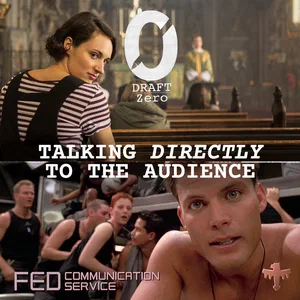
DZ-109: Talking DIRECTLY to your audience
What are the different ways a filmmaker can ask something of the audience?
AI✦Stu and Chas trace the spectrum from complete fourth-wall breaks in Fleabag to the diegetic awareness games in Zombieland, showing how character consciousness of the audience changes the effect entirely.✦
Listen if you've wondered what a character actually wants when they're talking directly to the audience!?
▶ More Info
What are the different ways a filmmaker can ask something of the audience… →
Films:
Fight Club (1999)
, Fleabag (2016)
, The Big Short (2015)
, F for Fake (1973)
, Star Wars (1977)

DZ-53: Antagonists! 5 - vs Audience
What if there is no antagonist?
AI✦The episode identifies direct address to the audience as a specific technique these films deploy to become antagonists themselves, collapsing the boundary between film and viewer.✦
Listen to turn narrative uncertainty itself into the engine that keeps viewers compelled.
▶ More Info
It’s time. The Epic Deep Dive(TM) into Antagonists has reached its shuddering conclusion. And for this Part V - by choosing films that have no obvious singular antagonist (and in some cases no obvious narrative either) - Stu and Chas realised there was indeed a final category of antagonists: the films themselves. Where the film (and the filmmaker) are engaging directly with the audience. Where the films are... VERSUS AUDIENCE… →
Films:
Ocean's Eight (2018)
, The Second (2018)
, F for Fake (1973)
, Sans Soleil (1983)
, Forrest Gump (1994)
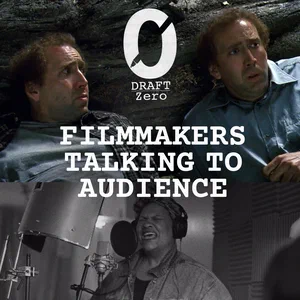
DZ-113: Tools For Filmmakers To Talk To The Audience
What tools help ensure that you as the filmmaker are not misunderstood?
AI✦All three films analyzed use techniques that acknowledge or break the fourth wall as a means of making the filmmaker’s presence felt and their thematic concerns transparent to the audience.✦
Listen if you want to explore how you can make your creative hand visible through meta-storytelling and structural choices!?!
▶ More Info
In our final (ha!) episode looking at Talking Directly to the Audience, we turn away from character-and-text based craft tools to look at other ways that filmmakers - whether they be directors, writers, editors, or anyone else - can make the audience feel their ‘hand’ more. To that end, Mel, Stu and Chas dive into ADAPTATION, STORIES WE TELL and THE FORTY-YEAR-OLD VERSION… →