
§ RESOURCES / TOPICS / Exposition
Exposition
Every episode covering Exposition.
"It’s very Minority Report, right, where they’re almost giving you, hey, we’re going to give you the audience bits that you need to know about the world by playing ads to the characters that we’re hoping you watch and you pick up on this like world building that we’re doing."
— Mel Killingsworth | DZ-109: Talking DIRECTLY to your audience
Start here

DZ-37: Excelling at Exposition (Part 1)
How can you successfully integrate exposition into your story?
AI✦The episode’s central focus is breaking down how great writers integrate necessary information--world rules, locations, character backstories, motivations--without halting narrative momentum.✦
Listen if your exposition scenes feel like information dumps disguised as dialogue.
▶ More Info
In Draft Zero’s first two part episode, Stu & Chas take an in-depth look at one of screenwriting’s most common challenges: EXPOSITION. For many stories there are pre-existing facts that need to be communicated to the audience — whether those facts be about the rules of the world, the nature of a location, character motivations, character backstories or just character names. So how have great writers made exposition move the story forward, rather than stopping it to tell the audience stuff they need to know… →
Films:
Pirates of the Caribbean: The Curse of the Black Pearl (2003)
, Short Term 12 (2013)
, Inside Out (2015)
, The World's End (2013)
, The Big Short (2015)
, It Follows (2015)
, Jurassic Park (1993)
, Jurassic World (2015)
DZ-38: Excelling at Exposition (Part 2)
How can exposition twist your story in new directions?
AI✦Exposition is the explicit subject of this episode, and Stu & Chas examine how great writers transform it from information delivery into dramatic revelation that shifts story direction.✦
Listen to learn how to use exposition as dramatic revelation rather than mere information delivery.
▶ More Info
In the second part of Draft Zero’s two-part episode on “Exposition”, Stu & Chas take an even deeper look at this notoriously challenging part of screenwriting. For many stories there are pre-existing facts (or given circumstances) that need to be communicated to an audience, and often we rely on dialogue to do it. But exposition can do more than just communicate, it can serve as dramatic revelation that twists a story into a new direction or provides an emotional payoff - or both!. So how do great writers make exposition work for the story, rather than just tell audience stuff they need to know? And how can writers go wrong… →
Films:
Gone Girl (2014)
, Shutter Island (2010)
, Ghostbusters (2016)
, The Matrix (1999)
, The Matrix Reloaded (2003)
, Captain America: The Winter Soldier (2014)
Even More
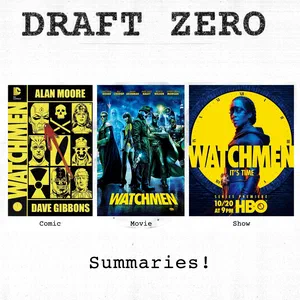
DZ-82: Dramatising Given Circumstances in WATCHMEN
How can you elegantly convey given circumstances and exposition?
AI✦The episode examines how both Snyder and Lindelof convey massive amounts of exposition -- character worldview, backstory, and world-building -- through the lens of given circumstances, demonstrating that the same information lands differently depending on presentation order and tonal context.✦
Listen if you're drowning your readers in world-building and can't figure out how to make it awesome!
▶ More Info
In this final podcast release of last year’s run of LiveSoLation episodes, Chas and Stu are joined by Uber-geek Mel Killingsworth (who else?) in an epic exploration of how Dave Gibbons’ and Alan Moore’s seminal graphic novel WATCHMEN is adapted differently in Zack Snyder’s 2009 film and Damon Lindelof’s 2019 HBO television show… →
Shows:
Watchmen

DZ-58: Game of Thrones - Character Exposition
How can you let your characters tell us how they feel?
In watching Season 7 (and the first three episodes of Season 8) of Game of Thrones, Stu noticed that there were lots of scenes where characters either met for the first time or were reunited after a long time apart. In these scenes, the audience knows (or thinks they know) more than either character. And so the fascination, power and subversion comes from what the characters choose to reveal... or not… →
Listen to understand why what a character *doesn't* say reveals more than exposition ever could.
▶ More Info
In watching Season 7 (and the first three episodes of Season 8) of Game of Thrones, Stu noticed that there were lots of scenes where characters either met for the first time or were reunited after a long time apart. In these scenes, the audience knows (or thinks they know) more than either character. And so the fascination, power and subversion comes from what the characters choose to reveal... or not… →
Films:
Game of Thrones (2011)
Shows:
Game of Thrones
DZ-15: World Building Rules, Okay?
How does setting up rules help you build a world?
AI✦Chas and Stu demonstrate how to deliver necessary world information in opening pages through techniques like title cards and outsider characters, sidestepping clumsy exposition while still teaching your rules.✦
Listen when your opening pages feel like exposition dumps (which is bad, okay?)
▶ More Info
In our most epic/longest episode yet, Chas and Stu tackle world building in films. Specifically, how the rules make something a world and not just a setting. Starting with world-centric genres like sci-fi and fantasy, we also cover horror, crime drama and - er - “other”. We discuss a variety of techniques for setting up the rules of the world, including cold opens, voiceover, title cards and outsider characters! We’ve limited ourselves to the opening 3-5 pages... mostly... because (so the theory goes) they’re the pages that teach the audience how to read/watch your story/film… →
Films:
The Matrix (1999)
, Inception (2010)
, The Lord of the Rings: The Fellowship of the Ring (2001)
, Jurassic Park (1993)
, Pan's Labyrinth (2006)
DZ-44: Marvel - First Acts and Establishing Characters
How can your first act effectively establish your character journey?
AI✦The breakdown of MCU first acts reveals how these films handle the burden of establishing a new world, character backstory, and narrative stakes without grinding momentum to a halt.✦
Listen if your first act exposition feels clunky--the MCU has a schema for burying backstory inside character introductions.
▶ More Info
First Acts are hard. They have to set so much in motion, especially setting up characters. To help them understand how to write effective first acts better, Stu and Chas turn their analytical gaze to a franchise that has been refining and reiterating its first act “schema” for over a decade... THE MARVEL CINEMATIC UNIVERSE… →
DZ-39: Backmatter - Hitting LA, Receiving Feedback, and a Roguish One
How can writers make use of their time when hitting LA?
AI✦Follow-up listener questions about the two-part Exposition episodes indicate Stu and Chas fielded real reactions to their framework for handling backstory and world-building information.✦
Listen if you're about to network at a festival and have no idea what writers actually do with their time there.
▶ More Info
In another backmatter-only episode, Stu & Chas zig-zag through a range of topics. We talk about Chas’ experience(s) hitting both Los Angeles and the Austin Film Festival, effective networking, career capital, the art of receiving feedback, and Stu’s harsh Three Strikes Rule. We look back at the most important lessons we’ve learned about storytelling in 2016 and that leads us to talk about character choices in a little-known and little-talked about film called ROGUE ONE… →
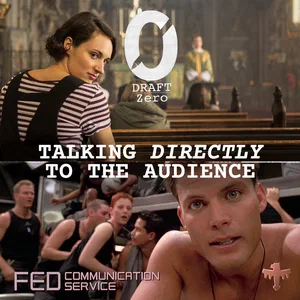
DZ-109: Talking DIRECTLY to your audience
What are the different ways a filmmaker can ask something of the audience?
AI✦Stu argues that these tools are underused when they’re deployed merely to deliver exposition and character backstory, and best deployed when they’re doing something dramatically purposeful instead.✦
Listen if you've wondered what a character actually wants when they're talking directly to the audience!?
▶ More Info
What are the different ways a filmmaker can ask something of the audience… →
Films:
Fight Club (1999)
, Fleabag (2016)
, The Big Short (2015)
, F for Fake (1973)
, Star Wars (1977)