DRAFT ZERO
§ RESOURCES / TOPICS / Conflict

Conflict

Every episode covering Conflict.


"Two people can be talking at cross purposes. Their words can be completely irrelevant to each other. In a way, it’s like they’re out of distance. They can’t cause any harm to each other. They can’t give or take anything away from one another — only when they move into measure. That there’s danger there."

— Damon Young  |  DZ-100: Scenes through Swords


KEY IDEAS

Emotional Measure

"Two people can be talking at cross purposes. Their words can be completely irrelevant to each other. In a way, it's like they're out of distance. They can't cause any harm to each other. They can't give or take anything away from one another -- only when they move into measure. That there's danger there."

— Damon Young (00:07:18) · DZ-100: Scenes through Swords

Fixed Mind

"Darth Maul was stuck on his tensions and conflicts from decades ago. And in any negotiation, in any argument, in any situation where you've got two characters who want something from each other or that the other's getting in the way of, you will have often something they can't get rid of, that they're stuck on, some kind of blockage, some sense that they're not quite attending to what they should be because their mind's on some grievance or some loss or some embarrassment or whatever it is."

— Damon Young (00:31:42) · DZ-100: Scenes through Swords

Asymmetric Awareness

"In some stories it's really fascinating to watch how maybe one of the characters doesn't really understand the situation they're in. They don't know they're in a negotiation. They don't realise they're actually in an argument. They're not aware they're being broken up with, or literally, they're not aware that they're in a fight. And it's watching how those different expectations are in conflict, not just the two people."

— Damon Young (00:52:39) · DZ-100: Scenes through Swords


DZ-49: Antagonists! 1 - vs Humans

What makes a strong human antagonist?
AIThis is Part One of a five-part series on different types of antagonistic conflict, with this installment narrowing focus specifically to human vs human as the primary narrative engine.
⏱ 1h 20m
31 MAR 2018
Listen if you want to understand how to craft compelling antagonists who oppose your protagonist through direct human conflict
More Info
Prompted by a listener (and patron of the podcast) question, Stu and Chas dive into antagonistic forces. And because Draft Zero does not do anything by halves, this is Part One of a Five Part Epic Exploration™ into antagonists; namely: vs humans, vs self, vs nature/supernatural, vs systems and “other”. aka the classic narrative conflicts…


DZ-45: Arguments of the Scene

How can you dramatise your theme on a scene level?
AIStu and Chas demonstrate that thematic conflict emerges when a character’s worldview collides with the dramatic circumstances of a scene, making worldview the generator of scene-level antagonism.
⏱ 2h 21m
27 OCT 2017
Listen to discover how a character's worldview becomes the engine of conflict inside a single scene.
More Info
As part of their ongoing exploration of scene-work, Stu and Chas apply their earlier thinking on theme and character worldview to individual scenes. Can examining a scene from a thematic perspective impact the drama, conflict or stakes of the scene? How does your character’s conscious and subconscious world views dramatise the overall theme of the work? How can an individual scene reflect the larger themes of the overall story? Do any of these questions or approaches lead to writing better scenes…


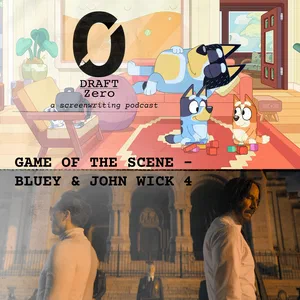
DZ-102: Game of the Scene - Bluey, John Wick 4

How can 'games' help us write better scenes?
AIThe games in scenes like Bluey’s ‘The Quiet Game’ and ‘Phones’ function as the engine of conflict itself, turning what characters want against what the rules allow them to do.
⏱ 1h 23m
31 AUG 2023
Listen to make your scene writing more dynamic (by looking at the underlying game)
More Info
Stu and Chas turn their attention to a topic that has long eluded them: the game of the scene. We look at how considering the game that characters are playing — its rules, arenas, players, referees, and win conditions — can help you write more dynamic scenes…


DZ-100: Scenes through Swords

What scene-writing tools can be learned from martial arts?
AIThe episode uses sword fighting mechanics--who engages first, how characters close distance, feinting and vulnerability--as a toolkit for writing scenes of actual confrontation.
⏱ 1h 0m
29 MAY 2023
Listen if you want to know why the distance between two characters matters more than what they say.
More Info
In this slightly unusual episode of Draft Zero (but also incredibly on brand), Stu and philosopher-swordsperson Damon Young discuss how the lessons they have learned from martial arts can be applied to scenes. In particular, they discuss how approaching an opponent in a sword fight can be analogous to how characters approach conflict, such as: the distance between the characters, who chooses to engage first, how to feint, how to lure an attack by leaving yourself vulnerable, etc…